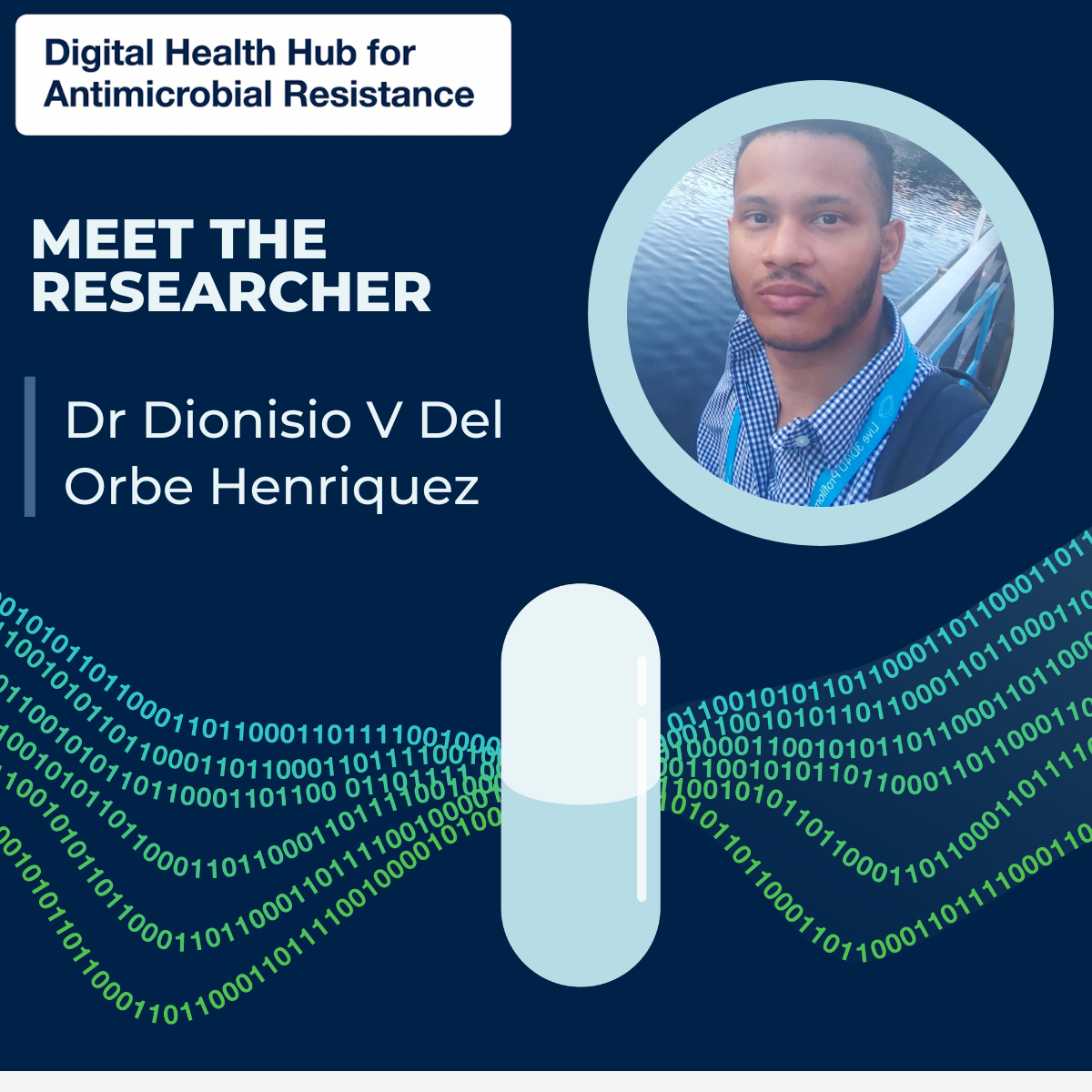
Meet the Researcher: Dr Dionisio V Del Orbe Henriquez
This summer, the EPSRC Digital Health Hub for AMR was delighted to welcome Dr Dionisio V Del Orbe Henriquez, a participant in Health Data Research UK’s Health Data Science Black Internship programme, who undertook his research placement with our teams based at Bangor University and the University of Sheffield.
With an academic background covering engineering and data science, Dionisio’s project focused on mapping the progress of digital dashboards for AMR surveillance and stewardship.
What is your background, and what has sparked your interest in starting a career in research?
I hold a bachelor’s, master’s, and PhD in Engineering. I have worked as a research assistant in at least four different groups around the world. More recently, I completed my master’s degree in data science. I really enjoy exploring and discovering the unknown. I find it fulfilling when new knowledge can be applied to address society’s most pressing issues. In particular, health data science is particularly interesting to me because of the rigour involved and the impact it has on the general population.
Can you explain your internship project?
I conducted a scoping literature review and evaluation of dashboards dedicated to antimicrobial resistance surveillance (AMR) and stewardship (AMS). This review aimed to map the progress in the use of data visualisations to support AMR surveillance and AMS. Through this, I learnt how to conduct such reviews and how to use analytical tools (Python and R) to illustrate the findings of the review. As researchers, we do not often have the chance to conduct such detailed reviews and to use data science tools to address predefined objectives about existing literature. Thus, I am very grateful to have had the time to develop this valuable skill under such great supervision.
Did you face any challenges?
Gathering background knowledge about AMR took some time, e.g., getting to know how antimicrobial resistance develops and how it is reported. However, Dr. Sealey and Dr. Zhuang were very supportive throughout our biweekly meetings, patiently addressing all my questions and doubts. By being open about the technical terms that I did not understand, I was able to conduct a more comprehensive review and identify connections and differences among the references.
What do you believe will be the most important piece of the puzzle in tackling AMR?
Based on my findings from reviewing AMR/AMS dashboards, I believe that one of the most critical elements is incorporating data/features that support decision-making. For instance, some dashboards integrate AMR and AMS data for specific regions and use indicators that bridge both areas (AMR + AMS), such as the drug resistance index. Incorporating AMR/AMS data in dashboards is key to supporting informed decisions. Of course, this should be done following a One-Health approach. In a broader perspective, I believe that it is very important to continue to educate the public about the current challenges AMR possess, i.e., the burden attributed to it and how challenging some of these microorganisms are to treat.
Dionisio’s work cements the growing importance of data integration and visualisation tools in tackling antimicrobial resistance - helping researchers, clinicians, and policymakers make more informed decisions.
Dr Mengdie Zhuang, Deputy Director and Training Lead of the Digital Health Hub for AMR said: “Dionisio’s review provides valuable insights into how data dashboards can support global AMR surveillance, we were thrilled to host Dio as part of HDRUK’s Black internship programme and look forward to seeing his career in digital health and data science continue flourish.”
The Digital Health Hub for AMR is proud to support initiatives like HDRUK’s Black Internship scheme, which provides early-career researchers with opportunities to gain hands-on experience at the intersection of data, health, and global impact.