Reflections from the Bridging the Future Summer School workshop
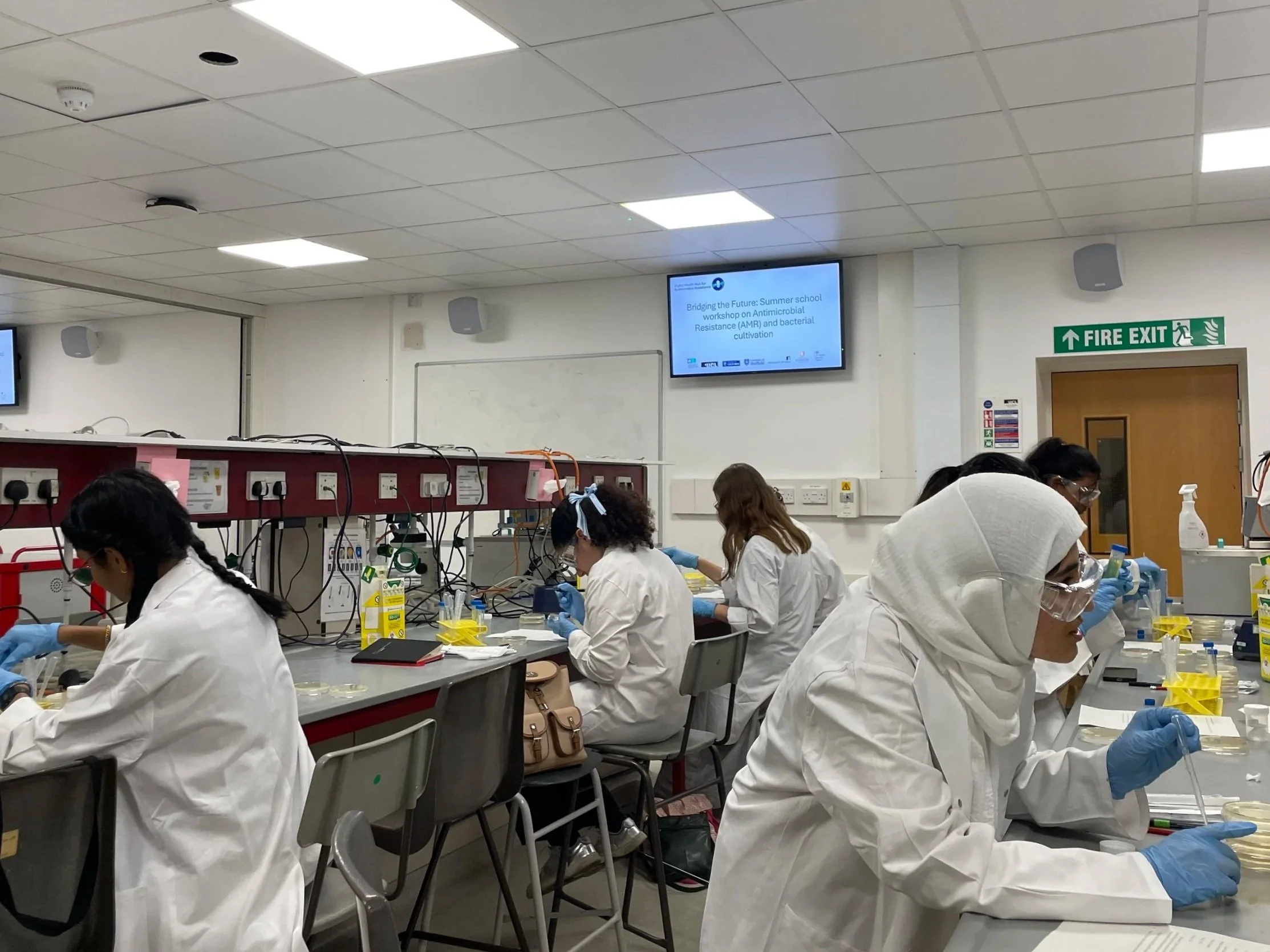
As part of the Bridging the Future Summer School, research volunteers affiliated with our Hub delivered a hands-on workshop introducing young people from refugee, asylum-seeking, and migrant backgrounds to the science of antimicrobial resistance (AMR). The two-hour session involved cultivating contaminated water on agar plates - a simple yet powerful way of showing how microbes grow and how AMR connects to everyday life.
Three PhD researchers: Rande Dzay and Cara Roberts from Bangor University, and Igor Pantea from Imperial College London - led the session. Below, they share their reflections on the experience.
Explaining AMR in ways that connect
All three volunteers highlighted the importance of making AMR engaging and relatable.
Cara noted how students were already well-informed:
“I was pleasantly surprised by their knowledge on the topic - they were very engaged during Rande’s presentation and discussion. I always check in with the person I’m speaking with, and if they’re not following, I take a step back and explain the concept in a different way.”
For Rande, numbers and relatable examples worked best:
“Mentioning some basic statistics helped them understand the scale of the problem. I also linked AMR to common illnesses and explained how antibiotics sometimes won’t work.”
Igor reflected on the value of keeping things simple:
“AMR impacts people’s wellbeing and becomes a bigger problem the longer you wait. By removing unnecessary jargon and leaning into the students’ natural curiosity, we had insightful conversations.”
Making lab concepts accessible
The workshop was designed to strip back bacterial culturing techniques to their essentials - supported by analogies and visual demonstrations.
Food colouring was used to represent dilutions, creating a clear colour gradient.
Nutrient agar was described as “a jelly full of food for the bacteria.”
Droppers were used instead of pipettes so students could focus on the protocol rather than equipment.
Concepts were sometimes left intentionally unexplained, encouraging questions and deeper engagement.
As Igor explained:
“Analogies were crucial. For example, I compared dilution to dissolving sugar in water, then transferring some of that liquid into another cup. It helped the students grasp the idea without feeling overwhelmed.”
Students’ curiosity and enthusiasm
All three volunteers were struck by the students’ eagerness to learn.
Cara shared:
“Once we were in full swing of the practical, the students became very curious - not only about the experiment, but also about my own research. It was great to see those questions come through.”
Rande added:
“The students were curious about AMR, even if their career interests lie elsewhere. Understanding how to use antibiotics responsibly is valuable knowledge for everyone.”
Igor was equally encouraged:
“Some even asked if I was a real scientist! My answer was that I am trying to be one. What stood out was how intelligent, eager to learn, and capable of impact the new generation is.”
Takeaways and lessons for the future
For the volunteers, the experience highlighted both the impact and the opportunities for improvement in future workshops. As Rande put it:
“Programmes like this are instrumental in raising awareness of AMR - not just for children, but for adults too.”
The reflections of Rande, Cara, and Igor show just how much can be achieved when complex topics like AMR are broken down and made hands-on. Most of all, they remind us that by engaging the next generation through creative methods, we can spark interest and action that will help in the fight against AMR.