As the world marks World Antimicrobial Resistance (AMR) Awareness Week 2025, the EPSRC Digital Health Hub for AMR reflects on a year of collaboration, innovation, and impact in the global effort to safeguard antibiotics for future generations.
Established in 2023 to transform AMR surveillance and stewardship through digital technologies, the Hub continues to unite researchers, clinicians, public health experts, and industry partners across the One Health spectrum.
This year, the Hub’s Grand Challenge research exemplars made significant progress in developing digital tools to support AMR surveillance and prevention, highlights include:
Developing the foundations of a One Health Trusted Research Environment (TRE-OH), dashboards for wastewater-based AMR monitoring and new models for understanding pathogen transmission.
Clinical stewardship tools under development that use machine learning to predict when patients can safely switch from IV to oral antibiotics, and wearable technology to track healthcare worker mobility and reduce hospital-acquired infections.
Progress across diagnostics, integrating AI-driven image analysis for rapid tests, enhancing connectivity with NHS systems, and accelerating response times during outbreaks.
These efforts have led to nine major new academic, regulatory, and industry partnerships, 12 high-impact publications, and £83 million in leveraged funding to date.
Building skills and capacity for the future
Since its inception the Hub has trained 379 individuals across the UK and devolved nations through bespoke courses such as “R for AMR Epidemiologists”, “Digital Epidemiology”, and “Antimicrobial Resistance: A Multidisciplinary Approach.” These sessions were co-developed with partners including UKHSA, HSCNI, UCLH and the London School of Hygiene & Tropical Medicine - helping embed data science and digital innovation within national public health systems.
In addition, seven fellowships were awarded this year, supporting early-career researchers through projects spanning environmental metagenomics, behavioural science, and health data analytics.
Cross-sector collaboration
The Hub continues to build a strong ecosystem of partners across government, academia, and industry. Collaborations now include DEFRA, the Veterinary Medicines Directorate, Public Health Wales, the Scottish Environmental Protection Agency, the Pirbright Institute, and major tech and biotech partners such as Google DeepMind, Verily, Arup, and Global Access Diagnostics.
Public engagement
Public engagement has made excellent progress in the last year. Key highlights include co-sponsoring world-renowned The Naked Scientists’ podcast “AMR Unleashed: The Silent Pandemic”, which reached over 150,000 listeners globally. Further, through our involvement with New Scientist Live, we continue to make the science of AMR accessible and engaging. The team also delivered outreach activities such as hackathons, student workshops, and science festivals, inspiring the next generation of researchers and students.
Looking ahead
AMR remains one of society’s greatest global health threats. The Hub’s progress underscores the power of collaboration across disciplines.
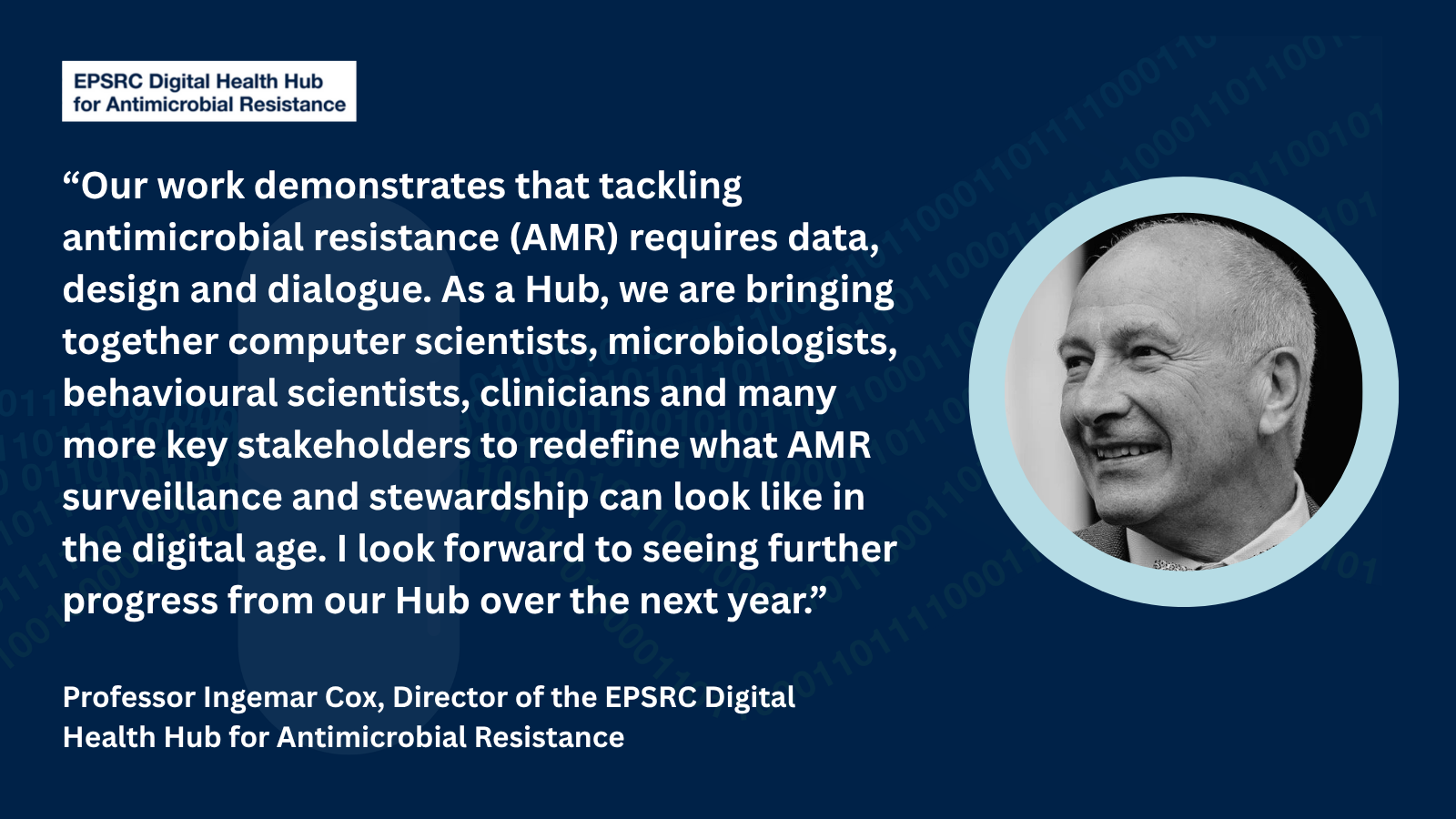
“Our work demonstrates that tackling AMR requires data, design and dialogue,” said Professor Ingemar Cox, Director of the Digital Health Hub for AMR. “As a Hub we are bringing together computer scientists, microbiologists, behavioural scientists, clinicians and many more key stakeholders to redefine what AMR surveillance and stewardship can look like in the digital age. I look forward to seeing further progress from our Hub over the next year.”