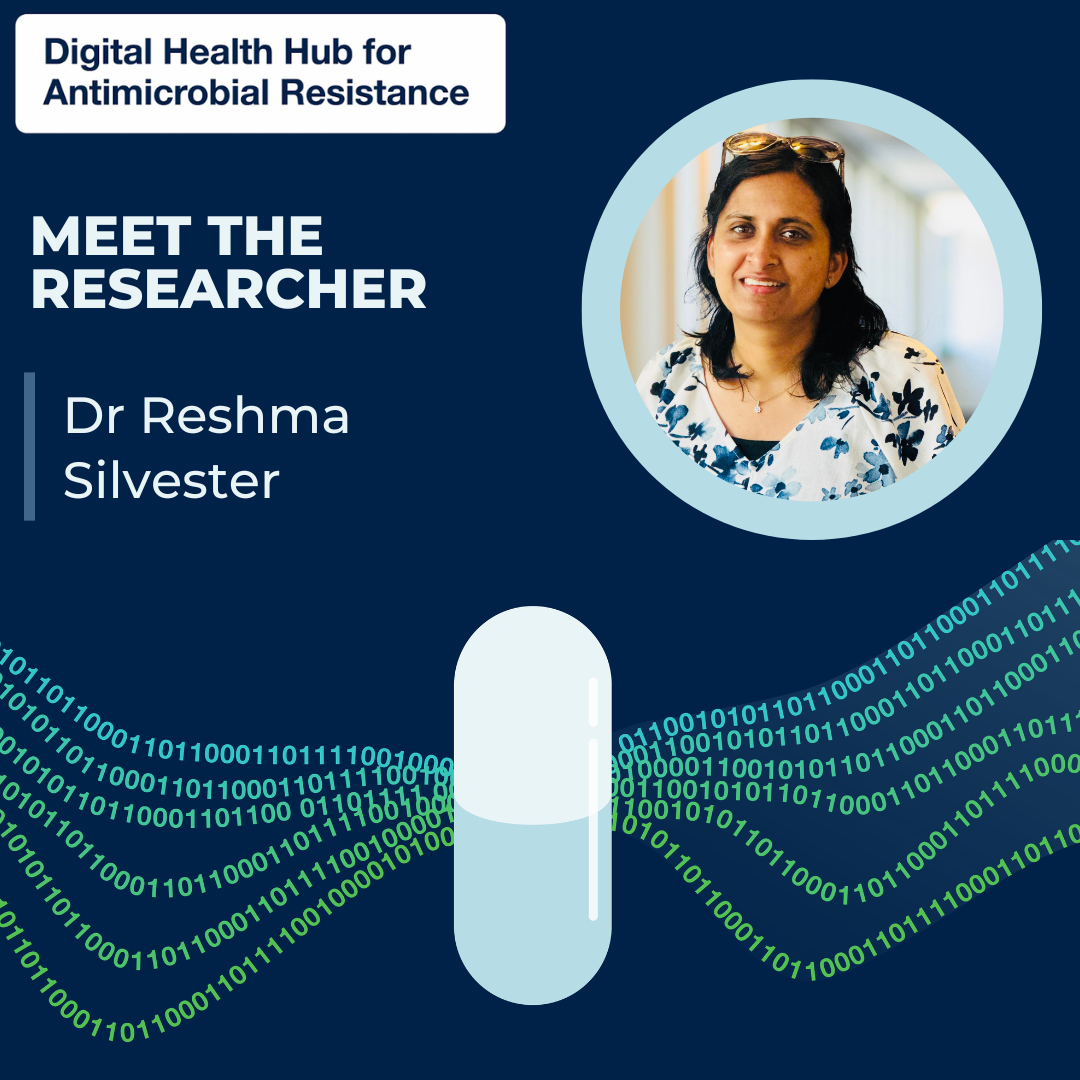
Meet the Researcher: Dr Reshma Silvester
Dr Reshma Silvester is a researcher within our Hub based at Bangor University, whose work sits at the cutting edge of antimicrobial resistance (AMR), environmental science, and digital health. With a background spanning microbiology, aquaculture, policy, and genomics, Reshma brings a uniquely integrated perspective to the AMR challenge. In this piece, Reshma shares why collaborative, One Health approaches are essential for the future of AMR.
What sparked your interest in starting a career in research?
My academic journey into the microbial world began during my B.Sc. and M.Sc. in Microbiology. It was during my Ph.D. that I discovered the complexity and urgency of research in AMR. My PhD focused on AMR in Vibrio spp. isolated from estuarine and shrimp aquaculture environments, highlighting the real-world consequences of antibiotic misuse and the role of environmental reservoirs in the dissemination of resistance, particularly its potential transmission through the food chain to humans.
During my Ph.D., attending national and international conferences further deepened my interest in AMR research, and also helped me appreciate the scale of the problem and its far-reaching impact across all domains, human, animal, and environmental health. This opened my eyes to the broader ‘One Health’ dimension of AMR and set me on the path I continue to follow today.
What has been a career highlight?
One of the key highlights of my career was working with the One Health Trust (formerly CDDEP) on the global mapping of AMR in food-producing animals. This role allowed me to explore AMR from a global policy and data-driven perspective, complementing my lab-based expertise with insights into large-scale surveillance, evidence synthesis, and the links between antimicrobial use in agriculture and resistance trends.
Following this, I was awarded the prestigious Chief Minister’s NavaKerala Postdoctoral Fellowship, which enabled me to lead research on mapping antimicrobial resistance and antimicrobial usage in aquaculture farming across the South Indian state of Kerala, India. This project deepened my understanding of AMR in aquatic environments and its implications for food safety and public health.
Two years ago, I stepped into the world of wastewater-based epidemiology (WBE) through my work at Bangor University within the wastewater surveillance group on the UK PATH-SAFE programme, a four-nation initiative, which has been equally rewarding. In this role, I lead AMR surveillance across hospital and community wastewater, environmental, and animal sectors. Being involved in this collaborative effort has allowed me to contribute to the development of integrated surveillance systems that support timely, data-driven interventions.
I have always been driven by the desire to contribute my best as a researcher to the global challenge of AMR. All these roles have reinforced my commitment to advancing integrated, One Health-based approaches for AMR surveillance and control.
Can you explain how your work sits within the Digital Health and AMR space?
My current research involves using advanced genomics and bioinformatics to conduct large-scale AMR surveillance through WBE within a One Health framework. This digital integration enables near real-time monitoring of AMR within the one-health sectors, providing a scalable and cost-effective complement to traditional diagnostics. It’s a great example of how environmental genomics is supporting digital health innovation.
Outside your day-to-day work, have you been involved in things that have influenced your research?
Participating in workshops, conferences, and stakeholder meetings and discussions focused on AMR, One Health, and wastewater-based epidemiology has been invaluable. These experiences have not only expanded my perspective but also continue to influence how I design research that is translational, collaborative, and grounded in real-world public health relevance.
What do you believe will be the most important piece of the puzzle in tackling AMR?
Integration and coordination between stakeholders including researchers, clinicians, veterinarians, environmental scientists, and public health authorities are essential to tackle AMR effectively. These groups must work hand in hand to complement one another’s efforts, rather than operating in isolation. Only through a genuinely collaborative, One Health approach can we build resilient systems that detect, respond to, and prevent the spread of resistance. Equally important is the translation of research into actionable policy. Without this crucial step, even the most robust scientific evidence may fall short of driving meaningful change in antimicrobial stewardship and public health practice.